Most people who want to get involved locally make the same mistake. They pick something brand new, something that needs a fresh slot in the calendar, and it lasts about three weeks. Then work gets busy, the evenings close in, and the whole plan quietly falls apart. The trick is to attach your involvement to something you already do. If you walk the dog every morning, walk it with a litter picker once a week. If you drop the kids at school, volunteer for the same school’s reading rota. If you already shop on a Saturday, add twenty minutes at the church hall cafe afterwards. Involvement that piggybacks on an existing routine survives a busy month. Involvement that demands a new one usually does not.
What follows is a practical checklist of ways to get involved in your local community, ordered roughly by how much time and commitment each one asks for. You do not have to do all of them. Pick one quick win this month, and see how it feels.
Quick wins: things you can try this week
Start here if you are not sure how much time you actually have. These options take an hour or two, need no training, and give you a real sense of whether you like the people and the pace.
Litter picking is the easiest entry point there is. Most councils lend a picker, gloves and bags, and many will collect a filled bag if you leave it somewhere sensible and tell them where. An hour along a verge or a footpath makes a visible difference, and it is genuinely sociable if you go with a neighbour. Village halls, parks and canal towpaths are usually the spots that need it most.
Community cafes and lunch clubs almost always need an extra pair of hands for a two-hour shift. You might be buttering bread, carrying trays, or simply sitting and chatting with someone who does not get out much. The chatting is often the part that matters. If you can spare a Tuesday lunchtime once a month, you are useful.
Donating goods is a quick win, but do it properly. Charity shops are drowning in unsorted bags, so ring ahead and ask what they actually need. Food banks usually publish a running list of what is short, and it is rarely what people assume. Pet food, nappies, toiletries and long-life milk tend to go fast. Turning up with a bag of the right things beats turning up with a boot full of the wrong ones.
Finally, there is the option nobody thinks of as volunteering: turning up. Going to a parish council meeting, a residents’ association evening, or a school governors’ open session counts. You learn what is actually happening, you meet the people who make things happen, and you find out where the gaps are. That knowledge is what turns a vague intention into a specific role.
Recurring roles: committing a few hours a month
Once you know you can hold a slot, recurring roles give you far more leverage than one-off gestures. The organisation stops having to find someone new every time, and you stop having to decide whether to go.
Charity shop shifts are the classic example. A regular three-hour slot, once a week or once a fortnight, is what keeps a shop open. You will sort donations, steam clothes, price books, work the till, or all four. It is surprisingly good fun, and you get first look at the stock, which matters more than you would think.
Food bank sessions need people who can commit consistently, because the same faces build trust with the people coming through the door. You might be packing parcels, carrying boxes to a car, or sitting with someone while they wait. Two hours a fortnight is a real contribution.
School and nursery volunteering is a good fit if you are already doing the school run. Reading with children, hearing times tables, helping at a forest school session, or marshalling a cross-country run all take an hour. Schools are usually desperate for men to volunteer, particularly in primary settings, because the vast majority of helpers are women. If you are a dad or a grandfather with an hour to spare, you will be welcomed.
Then there are the roles that keep small organisations alive: treasurer, secretary, minute-taker, safeguarding lead, bookings coordinator. These sound heavy, and some of them are, but a surprising number are lighter than they sound. Taking the minutes at a monthly meeting is perhaps ninety minutes of work a month, and it is the difference between a group functioning and a group folding. If you have any admin skill at all, you are more valuable than you realise.
Skills-based volunteering: using what you already do for a living
The fastest way to be genuinely useful is to offer the thing you are already good at. This is where busy people often find their best fit, because it uses existing competence rather than building a new one from scratch.
If you work in finance or accounting, a small charity or sports club probably needs a treasurer and cannot find one. If you work in marketing, a community group needs help with a leaflet, a poster, or a mailing list. If you are a tradesperson, a village hall has a leaking gutter and no idea who to call. If you are a teacher, a tutor, or a retired professional, there are young people who need exactly your subject. If you work in IT, half the committee is quietly panicking about the website.
The key is to be specific. Do not offer to help generally. Offer to do one clearly defined thing, with a start and an end. “I can redesign your booking form in the next three weeks” is a hundred times more useful than “let me know if I can help with anything.” Specific offers get taken up. Vague ones get politely filed.
Skills-based roles also tend to be more flexible than shift work. You can do a treasurer’s job at ten at night, once the house is quiet. You cannot run a cafe shift at ten at night. For anyone with a demanding job, that flexibility is the whole point.
Seasonal events and how to find the right group
Some of the easiest ways in are attached to events that only happen once a year. They are low risk, they are time-limited, and they put you in a room with people who are already connected.
Summer fetes, village shows, bonfire nights, Christmas fairs, school sports days, charity runs, park clean-ups, food festivals and remembrance parades all need marshals, stallholders, cake bakers, raffle ticket sellers and people to put chairs out and put them away again. A single afternoon of helping at a summer fete is a perfectly respectable way to start. You will meet the organisers, and they will remember you next year.
Seasonal events are also a soft way to test a group before committing. If you enjoy the fete committee, you might join it. If you find them exhausting, you have lost nothing but an afternoon.
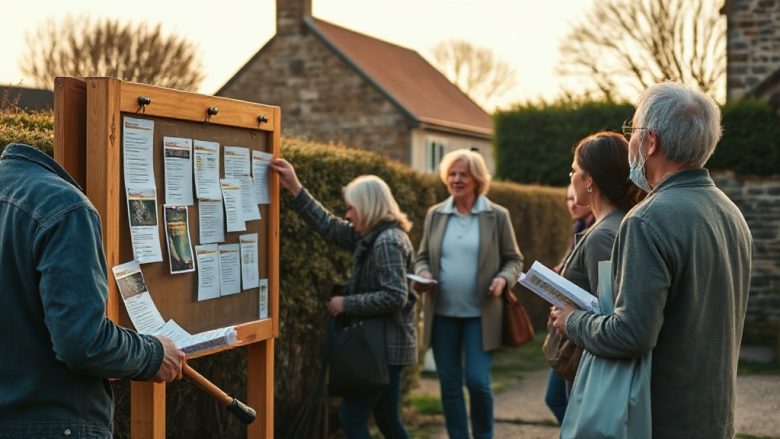
As for finding these groups in the first place, the honest answer is that there is no single directory that lists everything. The reliable routes are the ones that involve other people. Ask at the library, the post office, the corner shop, the pub, the church, the mosque, the temple, the school office and the GP surgery noticeboard. Ask a neighbour who seems to know everyone. Look at the physical noticeboards in your village hall or supermarket, which still carry things that never make it online. Check the parish council website, which usually lists local groups in its minutes. And when you find a group, ask them who else needs help, because community organisers all know each other.
One last piece of advice. Whatever you choose, tell someone you will do it. Not a grand public announcement, just a message to the organiser saying you will be there on Thursday. A small, specific promise is much harder to quietly abandon than a vague intention. That is what keeps involvement going when the month gets busy, and it is what turns a newcomer into a regular.