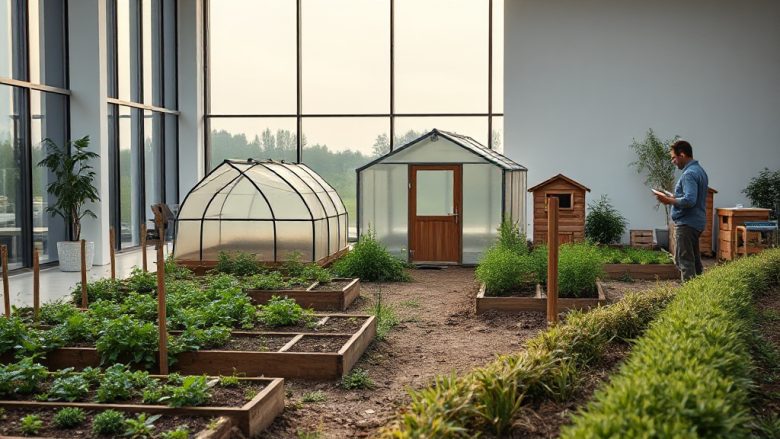
Most people choose a smallholding enterprise by how romantic it sounds. Chickens scratching around an orchard. Rows of cut flowers at dawn. Then the first winter arrives, the feed bill lands, and the whole thing collapses because nothing had started paying for itself yet. The question worth asking before you commit a single pound is simpler and much less charming: how soon does this idea repay what I’ve already spent? That’s what decides whether you’re still farming in three years or selling the kit on a classifieds site. Here are five realistic small scale farming business ideas, compared on startup cost, land needed, and time to first income.
The five models at a glance
Before the detail, here’s the honest summary. Figures below assume a UK smallholding, modest scale, and buying most inputs rather than making them. They’re rough ranges, not quotes, because your soil, climate, and local demand will shift everything.
| Model | Startup cost | Land needed | Time to first income | Main risk |
|---|---|---|---|---|
| Market garden | £2,000–£8,000 | 0.25–1 acre | 3–6 months | Weather and labour |
| Microgreens | £500–£2,500 | Under 100 sq ft | 3–6 weeks | Market saturation |
| Poultry (eggs) | £1,500–£6,000 | 0.2–1 acre | 5–8 months | Feed costs, disease |
| Beekeeping | £800–£3,000 | Small, flexible | 12–18 months | Colony loss |
| Herb production | £1,000–£4,000 | 0.1–0.5 acre | 4–10 months | Perishability, contracts |
Read that table by the time-to-income column first. It’s the one that keeps you solvent.
Market garden: the quickest route to real revenue
A market garden means growing vegetables and salads intensively on a small patch and selling them directly, usually through a box scheme, farmers’ market, or a handful of local restaurants. The whole point is that you don’t need acres. A quarter of an acre worked properly will out-produce a sprawling, badly managed field.
Startup costs sit in the low thousands. You’ll need seeds, compost, hand tools, a broadfork, irrigation, and some kind of polytunnel or fleece for extending the season. If you already own a rotavator and a shed, you’re ahead. The land requirement is genuinely small, but the labour requirement isn’t. This is a job, not a hobby, and it’s physical every single day of the growing season.
Income starts within three to six months if you plant fast crops first. Salad leaves, radishes, and herbs come in quickly. Potatoes and winter squash take longer and tie up ground. The trick is sequencing: get something sellable in the ground immediately so cash starts trickling in while the slower crops mature. Your first season won’t be profitable, but it can be cash-positive by midsummer if you’ve been disciplined about what you planted.
Where it goes wrong: underestimating how much you can actually sell. Growing is the easy part. Finding enough customers who’ll buy every week, not just once, is the real business.
Microgreens: tiny space, fast cash, crowded market
If you want the shortest possible path from spending money to earning it, microgreens win. You can grow them on shelving in a spare room, a garage, or a small polytunnel. Trays, seeds, growing medium, and a decent light setup will set you back a few hundred pounds if you’re frugal. Land needed is essentially nothing.
Time to first income is measured in weeks, not months. Most varieties are ready to cut in ten to twenty-one days. That speed is the entire appeal. You can test whether there’s demand before you’ve committed serious money.
The catch is that everyone else has noticed this too. Microgreens have become the default “easy” small scale farming business, and in many areas the market is already served by someone with a van and established restaurant accounts. Your advantage has to be freshness, reliability, or a niche variety nobody else grows. Selling to restaurants means consistent weekly volumes and a chef who’ll drop you the moment you miss a delivery. Selling at markets means you need to be there every week, rain or shine, with product that wilts by early afternoon.
It’s a brilliant first enterprise and a poor long-term one unless you scale into something with more margin. Use it to learn selling, not as a final destination.
Poultry for eggs: steady, familiar, and feed-dependent
Egg production is the enterprise most smallholders gravitate to, and for good reason. Customers understand eggs. They buy them repeatedly. There’s no marketing puzzle to solve.
A small flock of fifty to two hundred laying hens needs a decent coop, secure fencing against foxes, feeders, drinkers, and a reliable source of point-of-lay pullets. That’s where the £1,500 to £6,000 goes. Land requirement is modest, though you’ll want to rotate the birds or you’ll end up with bare, muddy ground and a parasite problem within two seasons.
Income takes five to eight months from setup because pullets need to reach laying age and you need to build a customer base. Once laying, hens produce reliably for a couple of years before output drops. The economics live or die on feed cost. Feed is your biggest ongoing expense, and if you’re buying it retail in small bags, your margin evaporates. Buying in bulk, or growing some of your own feed, changes the numbers significantly.
Disease and predation are real threats. One fox visit or one outbreak can wipe out months of work. Biosecurity isn’t optional, and neither is proper housing.
Beekeeping: slow money, small footprint, high uncertainty
Beekeeping appeals because it’s cheap to start and the land requirement is almost nothing. A few hives tucked along a hedgerow or in a corner will do. Hives, frames, protective clothing, a smoker, and extraction kit will cost somewhere between £800 and £3,000 depending on whether you buy new or secondhand.
But beekeeping is the slowest of these five to generate income. You won’t harvest meaningful honey in your first year, and often not much in your second. Colonies need to establish, build comb, and survive a winter before they’re productive. Realistically, twelve to eighteen months before you’re selling anything substantial.
Colony loss is the big risk. Varroa, harsh winters, and poor forage can kill a hive, and replacing it costs money and time. Honey yields vary wildly year to year depending on weather and what’s flowering nearby. Some years you’ll have a surplus; some years you’ll feed it all back to the bees.
It works well as a secondary enterprise, adding value to an existing farm or supplementing another income stream. As a standalone business, it’s slow and unpredictable. Bees don’t respond to your business plan.
Herb production: high value, tight margins, demanding customers
Culinary and medicinal herbs sit somewhere between market gardening and microgreens. You can grow them in a small area, and the value per square metre is high. Fresh cut herbs, potted herbs, and dried herbs all sell, and each has a different buyer.
Startup costs are modest, roughly £1,000 to £4,000 for seed, pots, compost, and basic infrastructure. Land needed is small, a tenth to half an acre is plenty. Income starts in four to ten months depending on whether you’re selling fresh cut herbs quickly or waiting for perennials to establish for dried production.
The difficulty is perishability and contracts. Fresh herbs wilt fast and need cold chain handling. Restaurants want specific varieties in specific quantities on specific days. Supermarkets and wholesalers want paperwork, consistency, and volumes you may not be able to guarantee. Dried herbs have a longer shelf life but a lower price point and more competition from imported product.
Where herbs shine is in direct sales. Farmers’ markets, farm shops, and local delis will pay well for fresh, unusual varieties that shoppers can’t find in a supermarket. Grow things like lovage, shiso, or unusual mint varieties and you’ve got a reason for people to seek you out specifically.
Choosing between them when land and capital are tight
If you have very little land and very little money, microgreens or a small herb patch gets you selling fastest with the least risk. You’ll learn what your local market actually wants, which is knowledge worth more than any of the equipment.
If you have a quarter acre or more and you’re prepared to work hard, a market garden offers the best long-term income potential of these five, but it demands the most consistent effort. It’s the one that can become a genuine full-time living.
Poultry suits anyone who wants something steady and familiar, provided you can source feed cheaply and secure the site properly. Beekeeping is best treated as a companion enterprise rather than a primary one, at least for the first two years.
The mistake almost everyone makes is starting three of these at once. Pick one. Get it to the point where it’s actually paying for itself before you add another. Cash flow is what decides whether you’re still farming next season, and the ideas that repay your first costs fastest give you the room to make mistakes without losing everything.
Start small, sell early, and let the money tell you what to do next.